Hi, I’m

Kaariz Hussain

Operations & Project Coordinator. I run the day-to-day — events, vendors, budgets — and when the process itself is the problem, I build the tool that fixes it.

01 — About

A little about me

I'm an operations and project coordinator with 4+ years running concurrent events, vendor relationships, and budgets in fast-paced, client-facing environments.

The pattern in how I work: run the process, find where it's quietly costing everyone time, then build the fix. Usually that means SOPs, trackers, and training. Sometimes it means software — which is how Prospect happened. I watched job-search tracking fall apart across spreadsheets and inboxes, so I shipped a free tracker that real job seekers now use. I use AI tools daily to move faster on both.

  • Based inNew Rochelle, NY
  • FocusOperations & Project Coordination
  • CurrentlyOpen to full-time roles
  • ToolsJira · Asana · Notion · Claude

02 — Experience

Where I've worked

  1. 2026 — Present

    Founder · Prospect

    Design, build, and ship a free job-search tracker end to end — directing development, launching publicly, and iterating on what real users need.

  2. 2021 — 2025

    Lead Operations Coordinator · Pop In! Playspace & Cafe

    Managed 2–5 concurrent events weekly and fielded 70+ weekly client and stakeholder communications, with no missed deadlines across four years. Built the SOPs and trackers that kept operations consistent as the business scaled, trained 10+ new hires, and coordinated vendor relationships across catering, entertainment, and facilities.

  3. 2017 — 2022

    Sole Operator · Independent E-Commerce

    Generated $10,000+ in annual profit operating a multi-platform resale business across Depop, Grailed, and eBay, managing 1,000+ transactions independently.

03 — Work

Selected projects

Select any project to read the full case study.

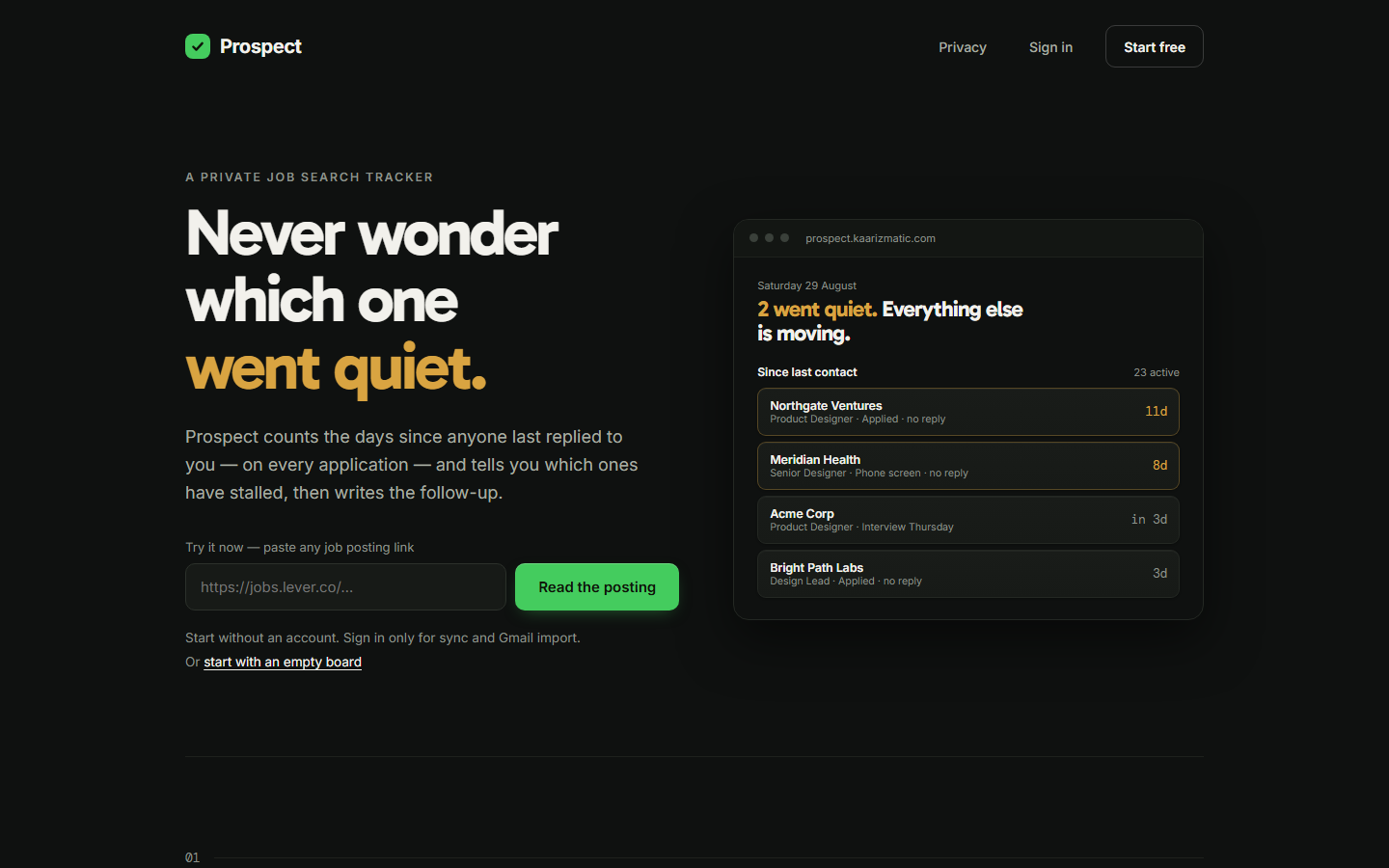
Prospect landing page, showing a job-search board that counts the days since each employer last replied.

Prospect — case study

What it does

Keeps every application, status, and follow-up in one place, so a job hunt stops living across spreadsheets, inboxes, and memory.

My role

Founder — I directed the product and the build from empty repo to public launch, and I keep shipping based on what real users need.

Visit the live app →
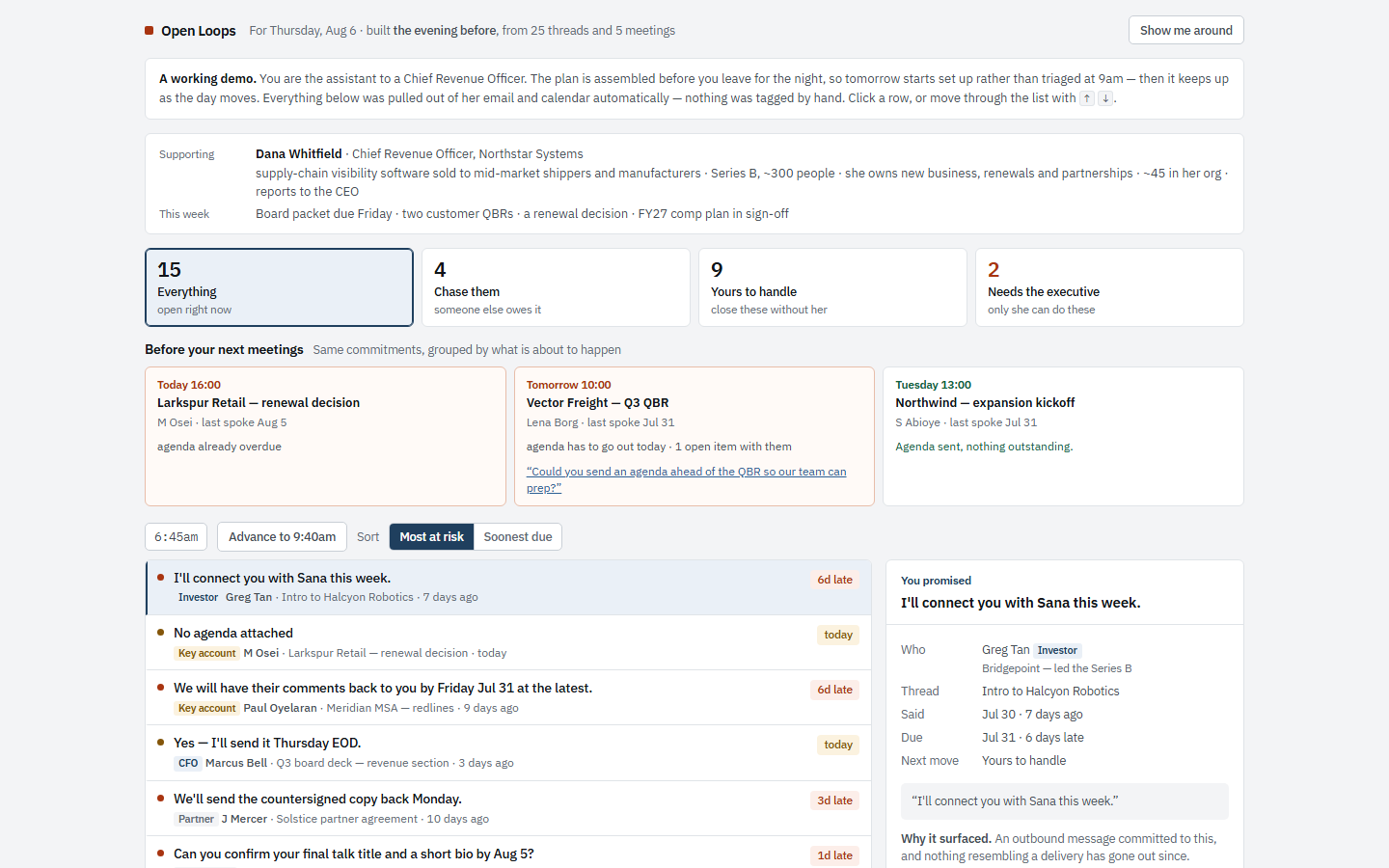
The Open Loops dashboard: counts of open commitments, a panel grouping them by upcoming meeting, and a ranked list of promises with days overdue.

Open Loops — case study

An executive assistant's real job isn't scheduling — it's being the safety net.

Someone promised something three weeks ago in a thread nobody reopened, and no system knows about it. Open Loops reads the mail and the calendar, extracts the promises, works out which ones already closed on their own, and ranks what's left by how close it is to falling over.

The parts that were actually hard

  • Deadlines live in the wrong message — "I'll get back to you before the deadline" carries no date; it was in the message being replied to. The engine walks back up the thread to find it.
  • Closure has to be automatic — a tracker you tick off by hand is just a second to-do list, which is the thing it was meant to replace.
  • False positives are the whole game — "let me know" is an ask, not a promise. An untrusted digest gets ignored by day three.
Open the live demo → Read the code →
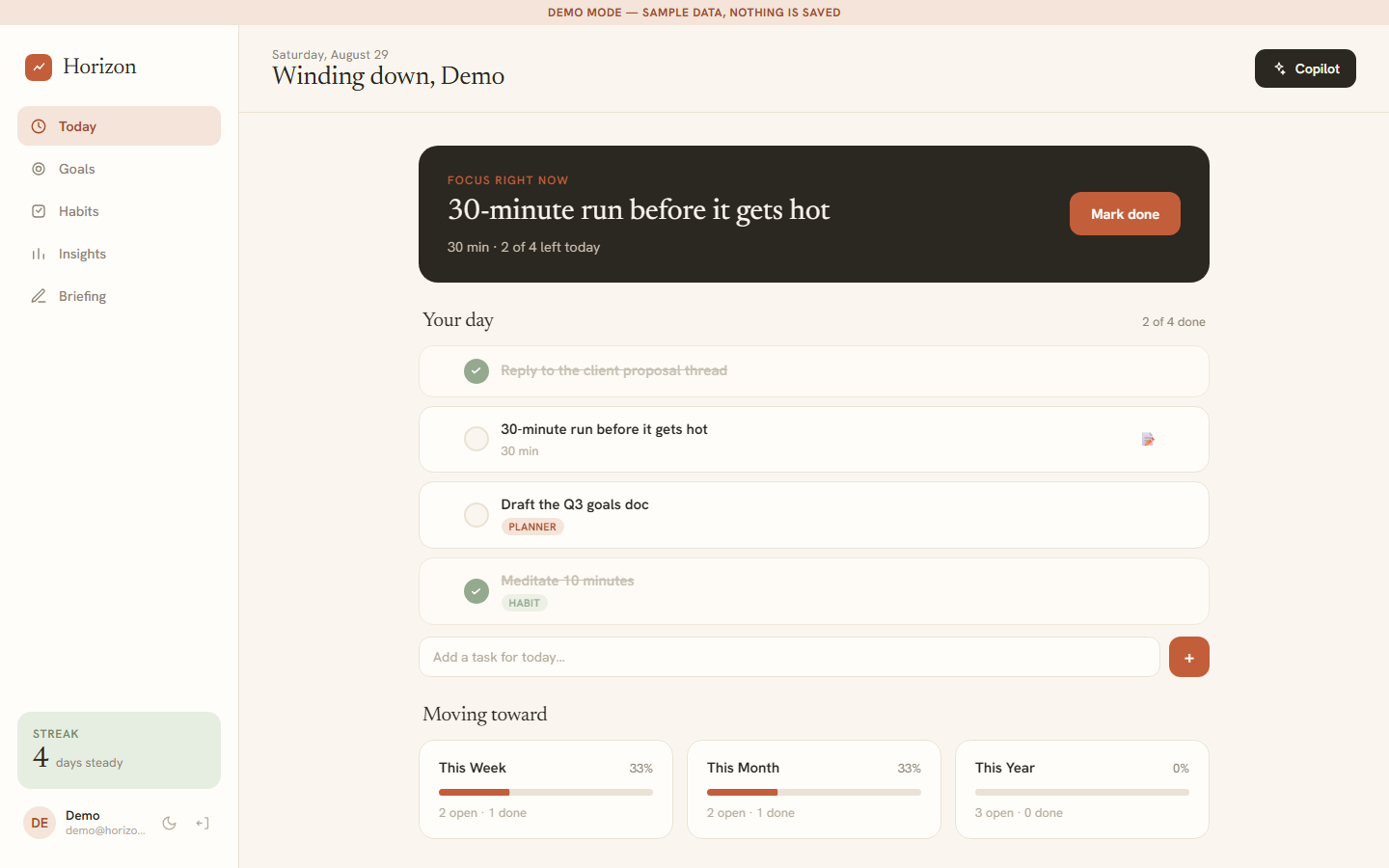
The Horizon dashboard in demo mode: a focus card for the current task, the day's task list, a streak counter, and progress rings for week, month and year.

Horizon — case study

What it does

Goals across four horizons — today, this week, this month, this year. Each morning a scheduled agent reads the board, a free-text briefing ("I work 9–5, gym M/W/F, deep work mornings"), and the calendar, then writes the day's itinerary. Unfinished tasks roll forward on their own.

How it runs

  • Static app on Vercel; Supabase Postgres behind owner-only row-level security
  • Three Deno edge functions — board snapshot, plan storage, message relay
  • A 7:05am planner and a 9:07pm check-in, both running as scheduled agents

The constraint I set

The calendar is read-only input. The assistant plans around what's already committed and never writes time blocks back — one bad inference shouldn't cost you a real meeting.

Try the live demo → Read the code →

FairPost — case study

The problem

A "Junior Project Coordinator" role asked for 3–5 years' experience, a PMP certification, and advanced Excel — for a job that was really scheduling meetings and updating status reports. A strong candidate read it, assumed they weren't qualified, and never applied. The company never knew why.

The MVP

  • Requirement Splitter — forces every requirement into must-have vs. nice-to-have, so teams see when they're over-filtering.
  • Bias Detector — flags gender-coded and elitist language, with plain reasons and alternatives.
  • Fairness Score — one 0–100 signal across language, requirements, transparency, and readability.

The risk I'd lose sleep over

That FairPost becomes a compliance shield — a high score that lets companies look fair on paper while biased hiring continues behind it. My guardrail: track downstream hiring outcomes, not just posting quality.

What I learned

An AI product's success has less to do with model quality than with whether it changes human behavior. The real challenge isn't intelligence — it's placement in the workflow, incentives, and enforcement.

View the full deck (PDF) →
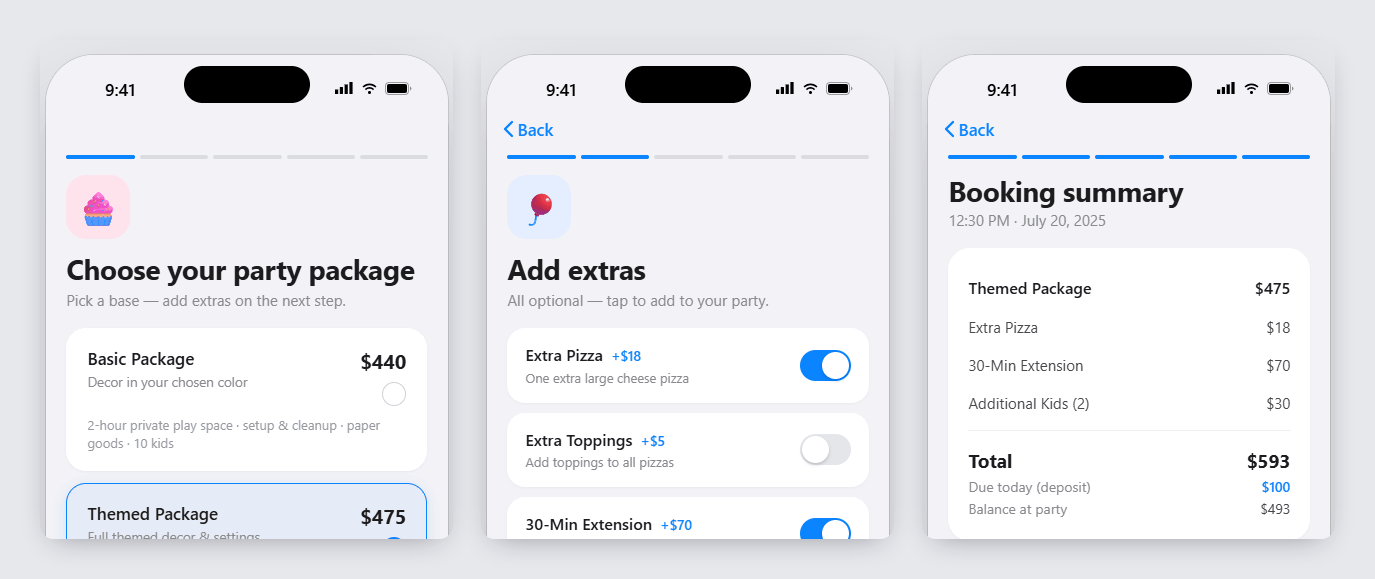
Three screens from the PartyPal prototype: choosing a party package with prices shown up front, adding extras as toggles, and an itemized booking summary with a $100 deposit due today and the balance due at the party.

PartyPal — case study

Booking a kids' party in under a minute — turning an afternoon of phone calls and unclear quotes into a few taps.

Parents booking a birthday for under-fives hit opaque pricing and a string of back-and-forth calls just to lock in a date. Stressful for families, and a constant interruption for the staff fielding the calls.

Key decisions

  • Show the running total, always — it removes the "how much will this actually be?" anxiety that drives the phone calls
  • One guest stepper instead of a confusing "additional kids" add-on — 10 included, $15 each after, capped at 30
  • A $100 deposit rather than full payment — lowers commitment friction for parents while protecting the venue's calendar

What I learned

MVP scope is easiest to define when it's anchored to a concrete business need, and user empathy is the fastest way to prioritize what ships first.

View the full case study (PDF) →

04 — Skills

What I bring

Operations & Coordination

  • Project planning & execution
  • Vendor & contract management
  • Event coordination
  • Budget tracking & invoicing
  • Client & stakeholder communication
  • Documentation & process improvement
  • Onboarding & training

Tools

  • Jira
  • Asana
  • Microsoft Office
  • Google Workspace
  • Slack
  • Notion
  • Canva
  • Claude
  • ChatGPT

05 — Education & Certifications

Credentials

06 — Contact

Let's talk

Have a project, a role, or just want to say hi? My inbox is open.

kaarizh@gmail.com